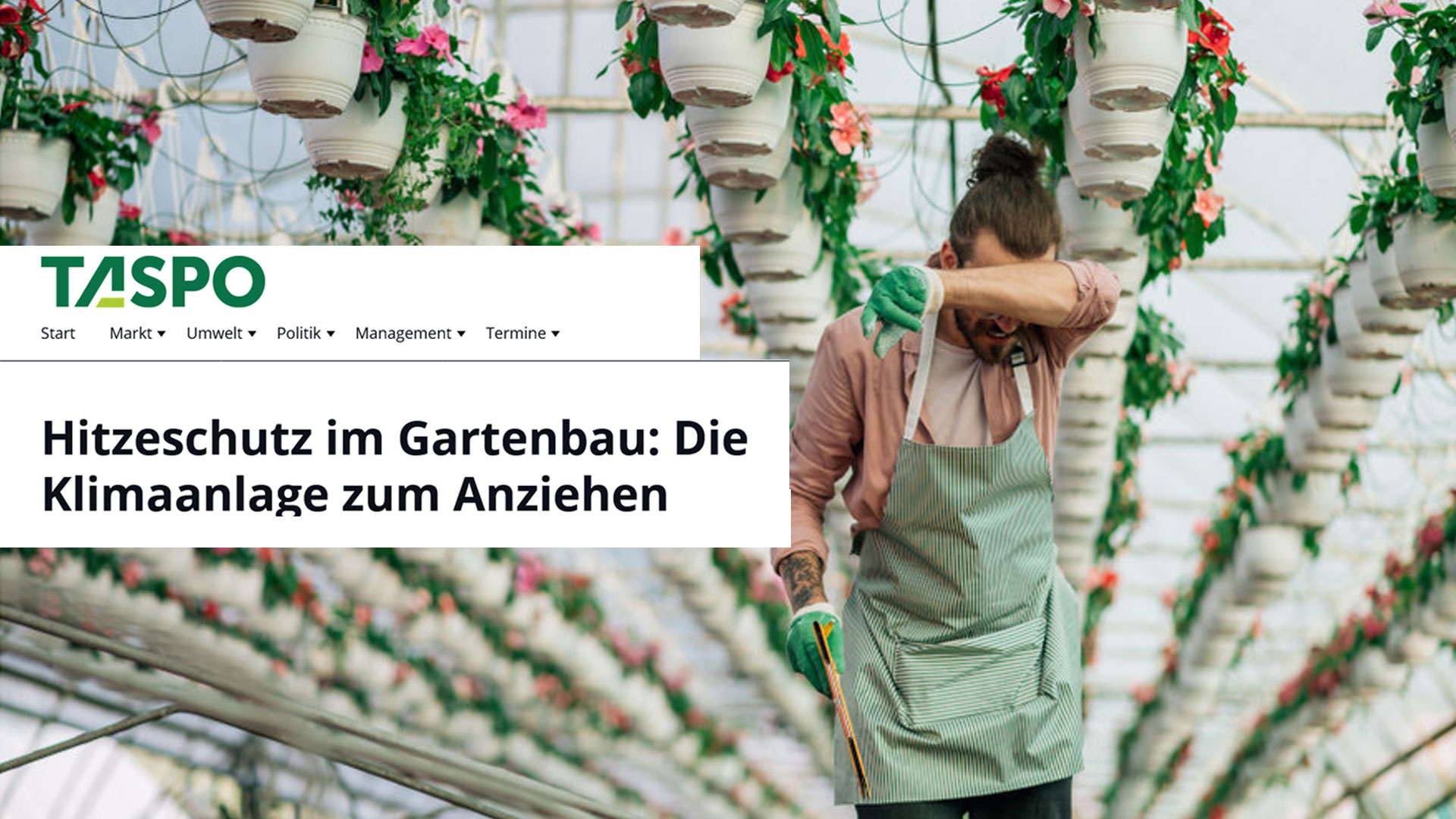
The increasing frequency of heatwaves demonstrates once again that heat has long since become an economic risk. For businesses, extreme heat not only places a strain on their staff, but also affects productivity, quality and, ultimately, profitability. Recent studies estimate the economic damage caused by a single day of heat of 30 °C or above in Germany at around 431 million euros. Effective heat protection and adaptation to climate change are therefore becoming crucial competitive factors.
One heatwave follows another – with consequences for businesses
Heatwaves are coming thick and fast this summer. What may initially sound to many people like simply having to cope with high outdoor temperatures has long since had tangible economic consequences.
Heat is becoming an increasing challenge, particularly for businesses. High temperatures not only take their toll on staff, but can also have a direct impact on productivity, quality and cost-effectiveness.
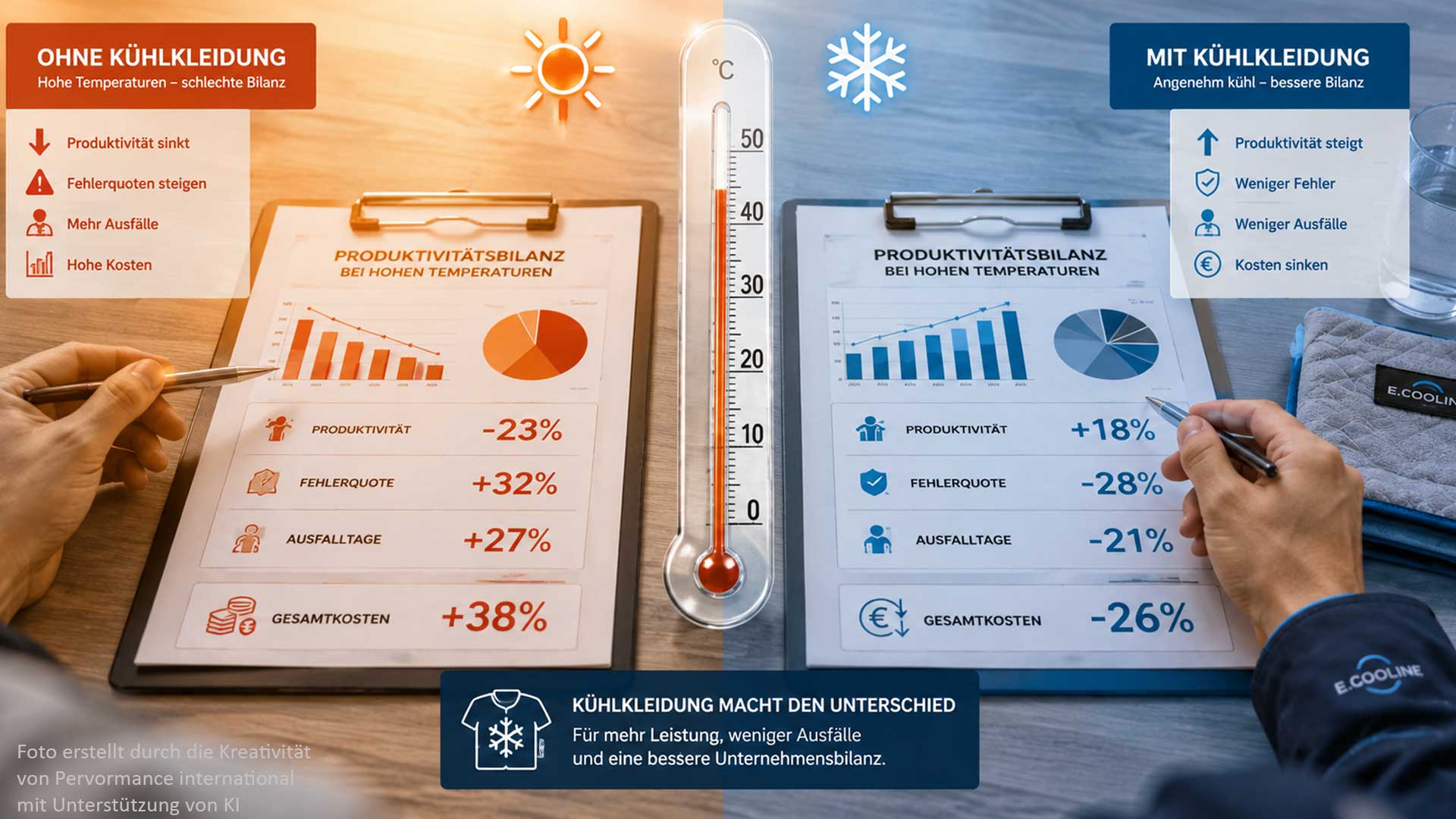
Declining productivity, higher error rates, increased absenteeism and health risks are no longer merely subjective impressions. The consequences of extreme temperatures are measurable.
Recent studies by Allianz Research and Prognos AG, commissioned by the Federal Ministry of Labour and Social Affairs (BMAS), highlight the economic scale that heat has now reached:
A single day of high temperatures of 30 °C or more causes around 431 million euros of economic damage in Germany.
Around 97 per cent of these costs are attributable to productivity losses. Added to this are absences from work, accidents at work and around 76,500 heat-related days of absence – on just a single hot day.
Just three days of hot weather have thus resulted in economic losses totalling more than 1.29 billion euros.
The findings from Allianz Research and Prognos make it clear that climate adaptation is becoming significantly more important for businesses from an economic perspective – and is no longer merely a matter for the future.
Why heat affects productivity in the workplace
Heat becomes particularly problematic at temperatures of around 30 °C and above. As temperatures rise, productivity can drop significantly.
In hot weather, the human body has to expend more and more energy to regulate its own temperature. At the same time, the physical strain increases.
Für Unternehmen können daraus vielfältige Folgen entstehen: Leistungsfähigkeit und Konzentration können sinken, während Fehlerquoten, gesundheitliche Belastungen und das Risiko für Arbeitsausfälle und Arbeitsunfälle steigen können.
This is particularly relevant wherever workers cannot simply avoid high temperatures – for example, in manufacturing and logistics, in the skilled trades, or when working outdoors.
Protection against heat in the workplace is therefore not just a matter of well-being. It is becoming an important part of health and safety, health management and organisational resilience.
Climate adaptation as an investment
Companies must not only prepare for individual heatwaves. They must increasingly factor rising temperatures into their investment, health and safety, and business strategies.
Preventative heat protection can help to,
- to protect the health of employees,
- to reduce heat stress and physical strain,
- To support performance and productivity on hot days,
- to reduce downtime,
- to improve health and safety at work and
- to strengthen the organisation’s resilience to heat and, consequently, its competitiveness.
Given that economic losses amount to 431 million euros per day of high temperatures, this is also changing the outlook for investment in heat protection.
The key question is no longer simply: How much does climate adaptation cost?
Rather: What does it cost companies not to invest in preventative heat protection?
Heat protection: Cooling with lower energy consumption
An obvious response to rising temperatures is to increase the use of air conditioning in buildings.
However, conventional building cooling requires additional energy. Depending on the technology and refrigerant used, this may also have further environmental impacts.
Internationally, the terms ‘climate adaptation’ and ‘non-maladaptation’ are used in this context: adaptation measures are intended to protect people from the consequences of climate change without unnecessarily exacerbating other risks or burdens.
This is exactly where cooling clothing comes in: cooling people rather than the whole room
Does an entire room need to be kept cool at all times if it is primarily people who need protection from heat stress?
Personal cooling takes a different approach: cooling takes place directly where it is needed – on the person.
The patented E.COOLINE® Smart Cooling Textiles utilise the physical principle of water evaporation to achieve this.
The textiles are activated by water. As the water evaporates, it creates a cooling effect that can be felt directly on the body.
To do this, the cooling textiles require:
- no mains power supply,
- no batteries and
- No refrigerants.
E.COOLINE thus offers a solution for personal heat protection that requires no additional electrical energy for the cooling process.
Cooling vests and cooling clothing as workplace heat protection
Personal cooling clothing can be particularly useful in workplaces where employees are directly exposed to heat or where the environment cannot be adequately cooled. E.COOLINE offers cooling vests, cooling shirts, cooling headwear, and arm and leg cooling solutions for employees working both indoors and outdoors.
A cooling vest, for example, acts directly on the body whilst working, rather than simply altering the temperature of the entire environment.
The potential benefits go beyond mere productivity. After all, less heat stress means less physical strain and can help to improve health and safety at work. And employees can finish their working day feeling less exhausted – an aspect that is becoming increasingly important in the face of growing heatwaves.
Investing in appropriate preventive heat protection measures can be economically significant.
The latest figures show why companies should increasingly consider heat protection from an economic perspective as well.
Given that a single day of extreme heat in Germany can cause damage amounting to around 431 million euros, the vast majority of which is attributable to losses in productivity, comparatively modest investment in preventive heat protection can make a significant contribution.
“The question is no longer whether we need to adapt to climate change, but how we can do so in an economically viable, sustainable and socially responsible manner,” says pharmacist Gabriele Renner, managing director of pervormance international GmbH. “Every euro invested in preventive heat protection does more than just safeguard health and safety at work. It ensures productivity, reduces downtime and strengthens the competitiveness of our businesses. Climate adaptation is therefore not a burden on the economy – it is an investment in its future.”
E.COOLINE: Smart cooling for a hotter working environment
With the patented E.COOLINE Smart Cooling Textiles, a market-ready technology is already available today that operates exclusively using water and requires neither electricity, batteries nor refrigerants. The product range extends from personal cooling clothing for indoor and outdoor workers, through cooling blankets and duvets, to smart cooling curtains for buildings. The common principle: cooling with water rather than with additional electrical energy.
The natural evaporation of water is specifically utilised for cooling. This provides direct protection for people, whilst limiting the additional energy required for air conditioning.
E.COOLINE thus combines three aspects that are becoming increasingly important in companies’ adaptation to climate change: health protection; cost-effectiveness; and energy consumption for cooling.
Climate adaptation is a key factor in competitiveness
The current heatwaves highlight what scientific studies have now backed up with figures: heat is an economic risk.
For businesses, this means that heat protection should no longer be viewed solely as a seasonal health and safety measure.
Climate adaptation is becoming a strategic business priority.
Modern occupational health and safety concepts, smart textiles and various cooling technologies can help to protect workers from heat stress, reduce losses in productivity and make businesses more resilient to rising temperatures. Effective cooling does not necessarily mean higher energy consumption.
E.COOLINE takes a different approach: it cools specifically where cooling is actually needed.
Conclusion: Companies should take action before the next heatwave. This is because a single day of extreme heat causes economic damage of up to 431 million euros. In other words, three days of extreme heat amount to more than 1.29 billion euros.
The figures show that heat is no longer just a matter of the weather.
It affects health, health and safety at work, productivity, quality and, ultimately, the competitiveness of businesses. Preventive heat protection is therefore becoming a key component of climate adaptation.
With E.COOLINE, businesses can start right with their staff: cooling through water evaporation – without the need for a power supply, batteries or refrigerants.
Get your business ready for the heat.
Don’t wait until the next heatwave starts to affect productivity and staff.
Discover the E.COOLINE® cooling vests and Smart Cooling Textiles for professional heat protection in the workplace – and find the right cooling solution for your staff.